Showing posts with label Freedom. Show all posts

Cameron on Civil Liberties

One of the most shaming aspects of Labour's record in office is its vicious decade-long assault on our freedom. In response, David Cameron will today make a speech outlining the Conservative Party’s thinking on the issue. Details are sketchy, but some of it, at least, we are already familiar with. The centrepiece is the proposed Bill of Rights. Opinion is divided on the issue of whether or not a Bill of Rights is the appropriate mechanism. My view is that we need an instrument that embeds our freedoms in a wider constitutional framework. Whatever the precise mechanism, it is clear that the doctrine of parliamentary sovereignty alone is no longer up to the job. The old constitutional settlement has simply become too unstable. Elements in the mix have become dangerously unbalanced, with far too much power concentrated in the executive. The most supine parliament in living memory has proved incapable of holding the executive to account, resulting in a raft of poorly drafted, ill-conceived legislation.

In part, the problem has been a succession of truly awful Home Secretaries. Lacking all historical awareness and understanding, oblivious to the delicate balance of freedoms and responsibilities that hold our system together, they have indulged the worst instincts of the Home Office. Between them, they have showed complete disregard for constitutional niceties, and in what amounted to a constitutional outrage allowed calculations of narrow party advantage to ride roughshod over longstanding constitutional and parliamentary protocols. None of this would have been possible, however, had these protocols been more clearly specified, the workings of our constitution been fully elaborated, and the limits to executive power more clearly spelled out. And so the conservatives need to give real thought to a wider package of constitutional reform.
Alongside proposals for a Bill of Rights, of course, there is also the commitment to abandon the costly and unnecessary ID card scheme, itself an important symbolic move, emblematic as it is of Labour’s wrongheaded approach to issues of security, but beyond this and vague noises about the repeal of some of the worst excesses of Labour’s anti-terror legislation, Tory proposals remain underspecified. Indeed, it is the Liberal Democrats who have made much of the running on civil liberties. Chris Huhne’s Freedom Bill remains the most conspicuous statement of intent by any of the main parties on the issue.

In view of Huhne’s contemptible support for the ban on Geert Wilders, however, there remain very real questions about the depth of the Liberal Democrats’ commitment to some aspects of the civil liberties agenda, in particular to the principle of free speech. Given the very real erosion of this fundamental right, there is no longer room for equivocation or ambivalence on this issue. I would like to see much more robust protection for free speech included in the bill, in particular real consideration given to repeal of the legislation outlawing incitement to religious hatred. That said, Huhne’s set of proposals is very nearly there. An excellent start, and the closest any of the parties has yet come to elaborating a set of proposals that genuinely reflect the concerns of civil liberties advocates.
This has left Chris Grayling struggling to catch up. Given the centrality of the Home Office to much of what Cameron will want to achieve in his first term, this situation cannot continue. There is a clear conservative case for constitutional renewal and reform. It is different from the one being made in the liberal press and it needs to be laid before the British people with vigour and energy. The Conservatives have a tireless advocate for civil liberties in David Davis, it is a pity Cameron cannot find his way to restoring Davis to the front bench.

Personality aside, it is crucial that the argument for civil liberties is not lost sight of in the lead up to the election. Issues around the economy and public spending have a tendency to crowd out arguments around civil liberties, especially in a downturn, relegating them to mere marginalia. Today's speech is a clear statement of intent from David Cameron that the Tories remain committed to rolling back Labour's ugly assault on our freedom. The defining feature of the New Labour landscape is a culture of petty cruelty and vindictiveness. A decade of it has left the public sphere horribly coarsened and disfigured. Cameron's speech today will go some way towards unwinding Labour's assault on our values and restoring some integrity to our constitutional settlement. It is also a reminder that there is more than one dividing line in this upcoming election. Quite apart from the distinction between a Conservative Party prepared to tell you the hard truth about public spending and a Labour Party determined to cover it up, the other big contrast is between a Labour Party pursuing an ugly authoritarian agenda and a Conservative Party committed to freedom. For me, Labour is simply on the wrong side of the argument on all of the big issues. Cameron's speech today is another emphatic demonstration of that.

*UPDATE: ConservativeHome has key passages from the speech here
**UPDATE: Full text here

And so it goes on

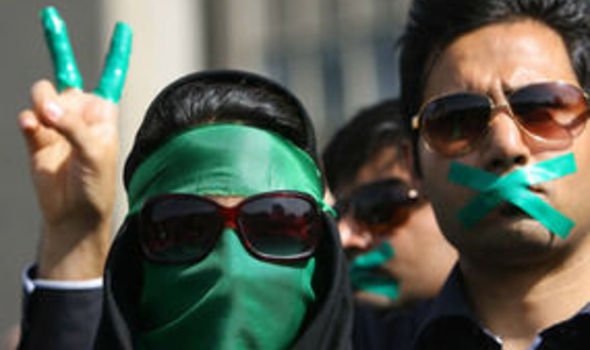
We wondered how Mousavi and the demonstrators would react to Khamenei’s provocation. We now have our answer. Mousavi remains uncowed, at the head of the protests. The uneasy stand off having given way to extremes of violence and brutality, the regime is now facing a deep crisis of legitimacy. Any semblance of a wider purpose has long since dissipated. All that remains is the authoritarian instinct, the reflexive illiberalism, the ugly philosophy of unfreedom. And Iranians are rejecting it.

As this crisis unfolds on Youtube, in our email boxes and our twitter feeds, the pressure to tilt policy in favour of the protesters grows. The clamour on the neoconservative right for a stronger line grows louder and more intense by the day. Obama has so far rightly resisted it. The best course of action was always to maintain a studied neutrality and that remains the case. So far Obama’s cautious realism has been pitch perfect; his call on the Iranian government to “stop all violent and unjust actions against its own people” managing to signal coded support for the protestors, while maintaining enough studied ambiguity to prevent accusations of meddling. And it must continue.

Predictably, the siren voices urging intervention - so far confined to the outer reaches of the neoconservative fringe - are in danger of breaking out and infecting the wider discourse. Just last night, our very own Iain Dale joined the chorus, urging a much more robust line on the government. Inchoate and lacking definition, these calls reflect a heartfelt desire to do something, anything, in the face of vicious brutality and injustice. On that very human level, they are understandable – admirable, even - but they make for bad foreign policy. Contra the ideologues on the neoconservative fringe, it is the job of those tasked with steering America through this crisis to eschew universalising, moralising rhetoric in favour of the cold calculation of interests.

And that is just what Obama and his team are doing. Watching, waiting, viewing this through the prism of enduring American interests, not allowing policy to get caught up in the swirl of events. One thing the neoconservatives are determined to do is to make this about America, to place America at the centre of the narrative; their growing impatience with Western inaction a rage against the idea of American impotence. One thing they cannot abide is an America on the periphery. This is a familiar kind of solipsism, one to which a young republic is especially vulnerable, and it must be overcome. The desire to insert ourselves at the centre of every crisis must be resisted. In its place there needs to be a much more disciplined and focused response. We need a diplomacy that comes to terms with and acknowledges limits. Thankfully, mercifully, after the excesses of the Bush years, that is exactly what we are getting.

All Eyes on Mousavi


Pity Mr. Mousavi. With the Supreme Leader’s speech this morning, the crisis in Iran has now entered its most critical phase. Until now, opposition forces have stopped short of challenging the legitimacy of the Islamic regime. By declaring for Ahmadinejad, however, Supreme Leader Ayatollah Khamenei effectively upped the ante this morning, placing both his leadership and the authority of the Islamic Republic on the line. The question now is just how far the opposition, and Mr. Mousavi in particular, are prepared to go. He and they have a choice; accept Mr. Ahmadinejad as President or plunge into the unknown. It boils down to a simple test of nerves. This was a calculated provocation by the regime and the pressure on Mr. Mousavi now is immense. How he will respond is unclear.

What is clear is that a proud people, an ancient people, a magical civilisation, beaten by this brutal regime into submission, aching for an end to the indignities visited upon them, have finally said ‘Enough!’. And so the siren call at the centre of Ayatollah Khamenei’s speech must be resisted. The turn away from politics to spirituality, towards the consolations of irrationality, unreason, faith, is the very opposite of what the Iranian people need. They have sought comfort in the false certainties of religion for too long. They of all people know that, of all the great pathologies that swirl around the Middle East, this is the most disabling, the most wretched; the most deceitful and wicked of all the great lies. What they want and need now more than ever, above all else, is for their politics to work.

And so what the Iranian people must understand above everything is that this speech was a deeply hostile act - at once a defiant, menacing, thuggish, brutal and yet ultimately self-defeating piece of political positioning, effectively setting regime and people on a collision course. If they understand that, the way forward will become clear. As the regime gathers its forces and the opposition draws breath, the world watches and waits, not knowing which way events will turn. My fervent hope is that the Iranian people will reject the false certainties and failed dogmas of the past, stand up, and assume something like their full height as a people.

A Lament


Some interesting contrasts between the American and British blogospheres have emerged over the course of the last week. In particular on the issue of the disputed Iranian elections. With the fall out from the expenses scandal and the developing argument over public expenditure dominating the conversation on this side of the Atlantic, developments in Iran have generated almost no comment. The American blogosphere, by way of contrast, has seized upon the issue and taken up the cause of the protesters with some relish. Andrew Sullivan has excelled yet again, standing head and shoulders above any other blog or mainstream news source, his grasp of the complexities and ambiguities around the issue a constant source of fresh insight and inspiration. But alongside him, the other big American blogs – Instapundit, Talking Points Memo, The Daily Kos - have all weighed in, contributing to a spirited dialogue.

In contrast, the issue just has not seized the imagination of the British blogosphere in the same way. The big political blogs in Britain have had almost nothing to say on the issue. The always insightful Heresiarch has chipped in here, but he remains something of a lone voice. And so what struck me is just how insular and self-absorbed the British blogosphere has become when compared with the American. Of course, the two countries are at very different points in the electoral cycle: the American response shaped by a newly confident, outward-looking administration, keen to make its mark – ours by a beleaguered, bewildered government, looking for all the world a demoralised and discredited rabble.

But the different reaction also reflects the widely different interests of the two countries. Iran is very much a live foreign policy issue in America and one of the most intractable foreign policy problems for American planners, whereas the Foreign Office is much diminished these days. Though still counted among the three great offices of state, the truth, of course, is that Britain no longer has a foreign policy worthy of the name. There is very little room for manoeuvre or creative thinking in the sphere of foreign policy. Despite our pretensions, the days when Britain conducted a global policy are long gone - the last great gasp of foreign policy activism in Iraq having dampened any residual desire on the part of Britain’s elites to put ourselves at the centre of the world's trouble spots. And so the different reactions to this story in America and Britain are something of an indicator both of how deeply engaged the Americans remain globally and how, at the same time, our interests - and perhaps our horizons - have narrowed; the different treatment of this issue by the respective blogospheres playing very much to the Americans’ credit and our shame, leaving the Americans looking every inch the worldly sophisticates and Britain the insular, parochial cousin.